
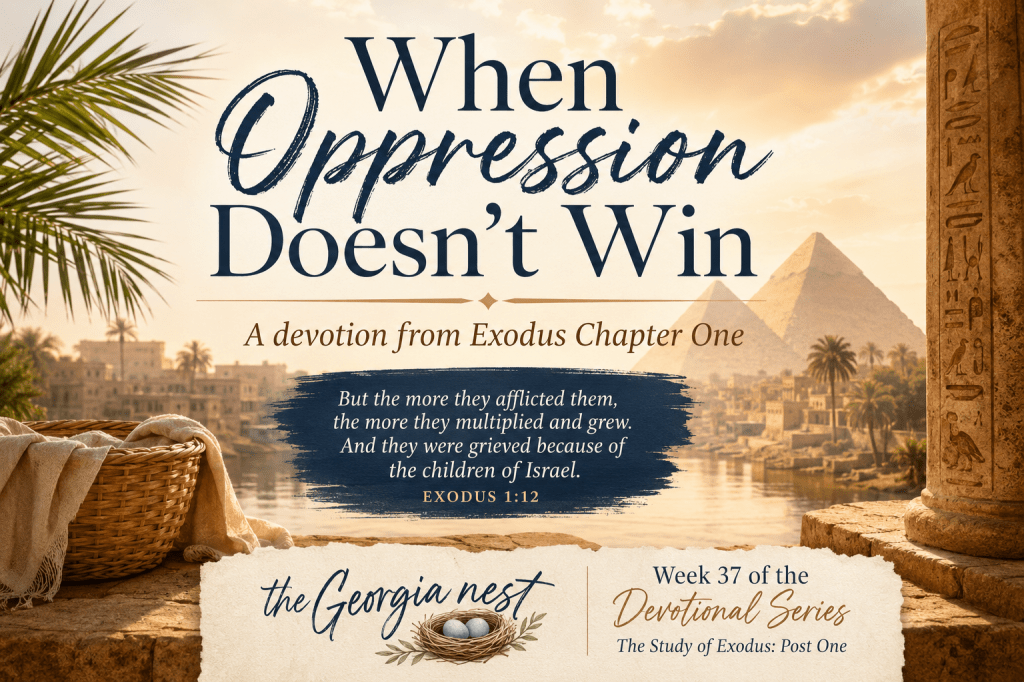
Week 37 of the Devotional Series

The Study of Exodus: Post One

***Note – We have completed the book of Job and the book of Genesis! This is our first week in the book of Exodus! 

Focus: Exodus Chapter One 

Tip: I highly recommend journaling your responses to the questions, prompts, and reflections. Writing them out can help you process more deeply and see how God is working in your life.

This week’s devotion includes:

Exodus Chapter One “ When Oppression Doesn’t Win”

Bible Memory:

Did you memorize last week’s Bible verse?

Hiding God’s Word in our hearts is such a valuable practice. Since I’ve been memorizing Scripture, I’ve experienced so many moments where God brings a specific verse to mind just when I need it most. It’s amazing how He uses His Word to speak into our lives right where we are.

This Week’s Memory Verse:

But the more they afflicted them, the more they multiplied and grew. And they were grieved because of the children of Israel.  

Exodus 1:12  

Exodus Chapter 1 

When Oppression Doesn’t Win

(Read Exodus Chapter 1 First) 

We have made it to our next book of the Bible…Exodus! I’m so excited to dive into this second book of Moses with you.

In chapter one, we read about something heavy right away…The oppression of the children of Israel.

Oppression means harsh and unfair treatment meant to break people down, control them, and burden them on purpose.

The chapter begins by reminding us of the sons of Jacob: Reuben, Simeon, Levi, Judah, Issachar, Zebulun, Benjamin, Dan, Naphtali, Gad, Asher, and Joseph. We remember Joseph was already in Egypt, but the rest of the family came later.

Over time, that entire generation passed away. But before they did, look what God did with that family. The Bible tells us…

And the children of Israel were fruitful, and increased abundantly, and multiplied, and waxed exceeding mighty; and the land was filled with them. Exodus 1:7

God was already blessing them.

A new king rose up in Egypt who did not know Joseph. But what he did see was how numerous and strong the Israelites had become and it made him afraid.

He decided he wanted to control them. 

So the Egyptians placed taskmasters over the Israelites to afflict them with heavy burdens. They were forced into slavery, doing the hard labor of building cities and working the land.

But here’s the part I love:

But the more they afflicted them, the more they multiplied and grew. Exodus 1:12 

When God is in control, what was meant by others to weaken you…won’t! What is meant to break you…won’t work! 

Since the harsh treatment wasn’t working, the Egyptians put on more pressure. Verse 13 tells us they were made to serve with rigour. That word means… harshness, cruelty, and oppression. Their lives became bitter with hard labor.

Now I know we are not in physical slavery, but we do know what it feels like to be:

  • Talked down to
  • Taken advantage of
  • Burdened by people or situations
  • Made to feel “less than”

Sometimes the goal of others is the same. It’s meant to break us down, control us, or make themselves feel superior.

But here’s the truth we can hold onto:

What people mean for harm, God can turn for good.

Just like the Israelites, what should destroy you doesn’t have to when God is in control. And you can allow God to use it to make you better and stronger! 

We also meet two Hebrew midwives in this chapter named Shiphrah and Puah.

The king of Egypt commanded them to kill the Hebrew baby boys at birth. But they refused.

Why?

But the midwives feared God, and did not as the king of Egypt commanded them, but saved the men children alive.  Exodus 1:17 

They chose to fear God more than man.

And God honored that.

He blessed them.

Real-Life Application:

This chapter gives us some nuggets of truths to live by:

  • Oppression doesn’t stop God’s plan
  • What is meant to break you doesn’t have to win.
    God can strengthen you in the very place meant by others to weaken you.
  • You choose who you fear
    Like the midwives, we will face moments where we must choose obedience to God over pressure from people.
  • God sees your faithfulness

Journaling Questions:

Take a few quiet minutes and really think about these questions and write them in your journal if you wish.

  1. Where in my life do I feel burdened, overwhelmed, or “oppressed” right now?
  1. Have I been allowing someone else’s words or actions to “break me down”?
  1. How have I seen God strengthen me in difficult seasons before?
  1. Am I more concerned with pleasing people or obeying God?
  1. What is one area where I need to trust that God is still in control?

Final Thought:

The enemy, or even people, may try to make things harder, heavier, and more overwhelming.

But trust that God WILL take the very thing meant to break you and use it to grow you.

Just like Israel, you can still multiply, grow, and become stronger even in hard places.

Week 36 of the Devotional Series

The Study of Genesis: Post Twenty-Four (The Final Post in Genesis)

***Note – We have completed the book of Job and this is our final devotion in the book of Genesis! We will continue our studies into the book of Exodus next week! 

Focus: Genesis Chapter 50

Tip: I highly recommend journaling your responses to the questions, prompts, and reflections. Writing them out can help you process more deeply and see how God is working in your life.

This week’s devotion includes:

Genesis Chapter 50 “ Overcome Evil with Good”

Bible Memory:

Did you memorize last week’s Bible verse?

Hiding God’s Word in our hearts is such a valuable practice. Since I’ve been memorizing Scripture, I’ve experienced so many moments where God brings a specific verse to mind just when I need it most. It’s amazing how He uses His Word to speak into our lives right where we are.

This Week’s Memory Verse:

Be not overcome of evil, but overcome evil with good.

-Romans 12:21 

Genesis Chapter 50

Overcome Evil with Good

(Read Genesis Chapter 50 First) 

We have made it to the last chapter in Genesis.

Jacob (Israel) has just spoken his final blessings over his sons, and now he’s gone. Scripture says that Joseph fell on his father’s face, wept over him, and kissed him. His heart was broken.

Then the very next verse says Joseph commanded his servants…the physicians.

Can we just pause there for a second? Joseph is commanding his servants… the physicians. The same man who was once thrown into a pit and sold into slavery is now in a position of authority and honor. Only God can write a story like that.

Joseph tells them to embalm his father. In those days, the embalming process took 40 days (verse 3). It involved removing the organs, drying the body with salt and spices, and wrapping it in layers of linen. It was done as a way to honor the one who had passed. And the Egyptians mourned him for 70 days.

When the mourning period ended, Joseph asked Pharaoh for permission to go bury his father in Canaan just like Jacob had made him promise. In the cave where his wife Leah was buried, along with Isaac and Rebekah, and Abraham and Sarah.

And Pharaoh said yes.

So Joseph went and he didn’t go alone.

All the servants of Pharaoh, the elders of Egypt, Joseph’s household, his brothers, and his father’s house went with him. The only ones left behind were the little ones and the livestock.

That’s a lot of people.

When I stop and picture that, this massive group traveling together just to honor one life and support one grieving family. They didn’t mourn alone. They went together and wept together. They felt deeply, openly, and fully.

Verse 10 says when they came to the threshing floor of Atad, they mourned with a “great and very sore lamentation” for seven days. It was so significant that the people of the land noticed and named the place Abel-mizraim, which means “the meadow of Egypt.”

After they buried Jacob, everyone returned to Egypt.

Joseph’s brothers start to get nervous. 

They begin to think, “Now that our father is gone… what if Joseph finally decides to pay us back for what we did to him?”

So they send a message to Joseph, saying that their father told him to forgive them.

And when Joseph hears this… he weeps.

We’re not told exactly why Joseph weeps. Maybe he was hurt that they still didn’t believe his forgiveness. Maybe he couldn’t understand why they were still carrying that fear. Maybe it was all of it.

Then his brothers come and fall before him, offering themselves as his servants.

And Joseph responds in one of the most powerful ways in all of Scripture:

“Fear not… ye thought evil against me; but God meant it unto good…”

He tells them not to be afraid. He promises to provide for them and their families. And the Bible says he comforted them and spoke kindly to them.

Look closely at his character:

They were evil to him… but he forgave them.

They left him for dead… but he said fear not.

They hated him… but he said I will nourish you.

They threw him in a pit… but he comforted them.

They took 22 years from him… but he spoke kindly to them.

That kind of response doesn’t come from human strength. That comes from a heart shaped by God.

It reminds me of these verses:

Matthew 5:44

“But I say unto you, Love your enemies, bless them that curse you, do good to them that hate you, and pray for them which despitefully use you, and persecute you;”

Luke 6:27-28

“But I say unto you which hear, Love your enemies, do good to them which hate you, Bless them that curse you, and pray for them which despitefully use you.”

Romans 12:20-21

“Therefore if thine enemy hunger, feed him; if he thirst, give him drink…

Be not overcome of evil, but overcome evil with good.”

Romans 12:17

“Recompense to no man evil for evil…”

1 Peter 3:9

“Not rendering evil for evil, or railing for railing: but contrariwise blessing…”

Proverbs 25:21-22

“If thine enemy be hungry, give him bread to eat…”

Don’t let someone else’s wrong change who you are.

When you respond with good, you protect your own heart. You reflect God’s character. And sometimes… you soften theirs too.

Journaling Questions:

1. Is there someone in my life I’ve “forgiven”… but still hold at a distance in my heart?

2. What would it look like to respond with kindness instead of protection or pride?

3. Do I truly trust that God can turn what was meant for evil into something good?

4. Where might God be asking me to say “fear not” instead of “you owe me”?

We close out Genesis with Joseph living to be 110 years old. He got to see his children, grandchildren, and even some of his great-grandchildren. What a gift.

Before he died, he told his brothers that God would surely bring them out of Egypt and back to the land He promised to Abraham, Isaac, and Jacob. And he made them swear to carry his bones with them when they went.

And the last verse tells us he was embalmed and placed in a coffin in Egypt.

But don’t let that feel like the end of the story.

Because God isn’t finished.

We’re about to begin in Exodus… and yes, Joseph’s bones will make it to the Promised Land.

God always keeps His promises.

Week 34 of the Devotional Series

The Study of Genesis Post Twenty-Two

***Note – We have completed the book of Job. Now, as we continue our journey through the Bible in chronological order, this is our 22nd devotion in Genesis. Though we’re in Week 34 overall, we’ll be in Genesis for the next couple of weeks.

Focus: Genesis 48

Tip: I highly recommend journaling your responses to the questions, prompts, and reflections. Writing them out can help you process more deeply and see how God is working in your life.

This week’s devotion includes:

Chapter 48 –“More Than I Thought I’d See”

Bible Memory:

Did you memorize last week’s Bible verse?

Hiding God’s Word in our hearts is such a valuable practice. Since I’ve been memorizing Scripture, I’ve experienced so many moments where God brings a specific verse to mind just when I need it most. It’s amazing how He uses His Word to speak into our lives right where we are.

This Week’s Memory Verse“And Israel said unto Joseph, I had not thought to see thy face: and, lo, God hath shewed me also thy seed.”  

Genesis 48:11

Genesis Chapter 48

More Than I Thought I’d See

(Read Genesis Chapter 48 First) 

Joseph was notified that his father, Israel (Jacob), was sick, so he took his two sons, Manasseh and Ephraim, to go see him. When they arrived, someone told Jacob they were there, and he strengthened himself enough to sit up in the bed.

I love that his first thought when he sat up was on God.

The first thing he tells Joseph is how God appeared to him long ago, blessed him, and promised to make him fruitful, multiply him, and give him the land of Canaan as an everlasting possession. Even though they were in Egypt instead of Canaan, Jacob had no doubt in what God had spoken. In verse 21, he reminds Joseph that God would bring him again to the land of his fathers.

That is great faith! Jacob still believed and trusted what God told him, even when his life didn’t look like what was promised

Let’s pause right here and journal or reflect: 

Sometimes our lives can look more like Egypt than Canaan.

We may find ourselves in places we didn’t expect and time passes. It can become easy to question if what God said will really come to pass.

But look what Jacob shows us. It’s powerful! He didn’t base his faith on what he saw, he based it on what God said.

So, what about us?

• Are we allowing what we can only see to shape what we believe?

• Have we let time or disappointment weaken our confidence in what God   told us?

• Are we still holding onto His promises with the same faith we had when   we first received them?

• Is there something God has spoken over your life that doesn’t look like   it’s come to pass yet?

• What would it look like to trust Him anyway?

Jacob does something interesting next. He tells Joseph that he wants to claim his two sons as his own so that he can leave them an inheritance just like his other sons. Then he briefly reflects on the loss of Rachel, reminding Joseph of his mother.

When Jacob notices Joseph’s sons, he brings them close, hugs them, and kisses them. And then he says something so powerful:

“I had not thought to see thy face: and, lo, God hath shewed me also thy seed.”

Just look at what God can do!

Jacob never thought he would see Joseph again and not only did he see him, but he saw his children too. What God restored went beyond what Jacob could have imagined.

Reading this also reminded me of this verse…“Now unto him that is able to do exceeding abundantly above all that we ask or think, according to the power that worketh in us,” – Ephesians 3:20

God often goes beyond what we even thought to ask for.

Journaling & Reflection

• Has there been a time in your life where God did more than you   expected?

• Are you limiting what God can do based on what you’ve seen so far?

Next, Joseph brings his sons before Jacob and bows himself. He positions them intentionally with his oldest at Jacob’s right hand and the youngest at his left, following the tradition that the greater blessing would go to the eldest.

But before Jacob blesses them, he begins with these words:

“The God which fed me all my life long unto this day… the Angel which redeemed me from all evil…”

Before he asks God to bless them, he acknowledges who God is.

He gives Him honor and reflects on God’s faithfulness. He remembers how God carried him his entire life.

That’s something for us to take note of.

God is not just someone we come to with our requests. He is more than worthy of our recognition, gratitude, and our praise.

Journaling & Reflection

• Do you take time to acknowledge who God is before asking Him for   things?

• What are some ways God has “fed you all your life long unto this day”?

What Jacob does next was a bit unexpected. He crosses his hands, placing his right hand on the younger son instead of the older. Joseph tries to correct him, but Jacob makes it clear that this was intentional.

God’s ways are not always what we expect. 

The younger would be greater. The blessing didn’t follow tradition, but it did followed God’s purpose.

Journaling & Reflection

• Has God ever worked in a way that didn’t make sense to you at the time?

• Are you open to God moving differently than you expected?

This part really made me think about legacy.

Both boys would become so influential that people would one day speak a blessing over others, saying, “God make thee as Ephraim and Manasseh.” (Genesis 48:20 KJV)

That made me stop and ask a deeper question…what kind of legacy am I leaving behind?

Not just in what I say, but in how I live. In what I model. In what I pass down without even realizing it.

I pray that one day my children and grandchildren will see something in my life worth following that points them closer to God. I want to live the kind of life that encourages others to grow, do better, and become better.

Journaling & Reflection

• What kind of legacy are you building right now?

If someone followed your example, where would it lead them?

Jacob’s final words to Joseph are full of faith:

“Behold, I die: but God shall be with you, and bring you again unto the land of your fathers.”

Even at the end of his life, Jacob points back to God’s promise that He once made him. 

Then he gives Joseph a double portion, an inheritance that would carry on through his sons.

Joseph had lived through years of hardship, uncertainty, and waiting. But God’s faithfulness brought him through and it overflowed into something greater than he could have imagined.

Final Reflection:

• Can you see ways God has been faithful to you, even through hard   seasons?

• Where might God be working in your life right now in ways you don’t fully   see yet?

Closing Thoughts:

As we close out Genesis 48, I keep coming back to that one simple but powerful line…I had not thought to see…

Jacob didn’t expect to see Joseph again. In his mind, that chapter was closed and the finality of that loss was accepted. The grief was something he had learned to live with.

And yet…God.

God restored what was lost, and He brought Jacob into a fuller, richer, and more meaningful life than he ever imagined possible.

He does that with us too! 

There are things in our lives we think… “that will never happen.” Prayers we’ve stopped praying. Hopes we’ve tucked away and forgotten. Situations we’ve accepted as “this is just how it is now.”

But God is not limited! He can still work and write stories for our lives that we never imagined possible. 

And sometimes, just like Jacob, we don’t fully see it until we’re in the middle of something we never thought we’d experience again…or maybe never thought we’d experience at all.

What I love most is that Jacob didn’t waste that moment. He used it to bless and speak life to the next generation toward God.

Don’t miss the invitation for us too.

We need to recognize God’s faithfulness and respond to it, to live in a way that reflects it, and to pass it on.

So wherever you are today…wether it be in a season of waiting, trusting, or finally seeing something come together, hold onto this truth:

God is able to do more than you think, see, or dare to hope for. 

And when He does…don’t miss it.

Let it deepen your faith, shape your legacy, and remind you that His story for your life isn’t finished yet.